
Healthcare Data Infrastructure: Building an AI-Ready Foundation for Scalable HealthTech
A Strategic Engineering Blueprint for Healthcare Founders, CTOs, and Product Leaders Navigating Interoperability, HL7 FHIR Integration, and Clinical AI Scaling
Healthcare data is everywhere - but it rarely arrives in the same shape, language, or system.
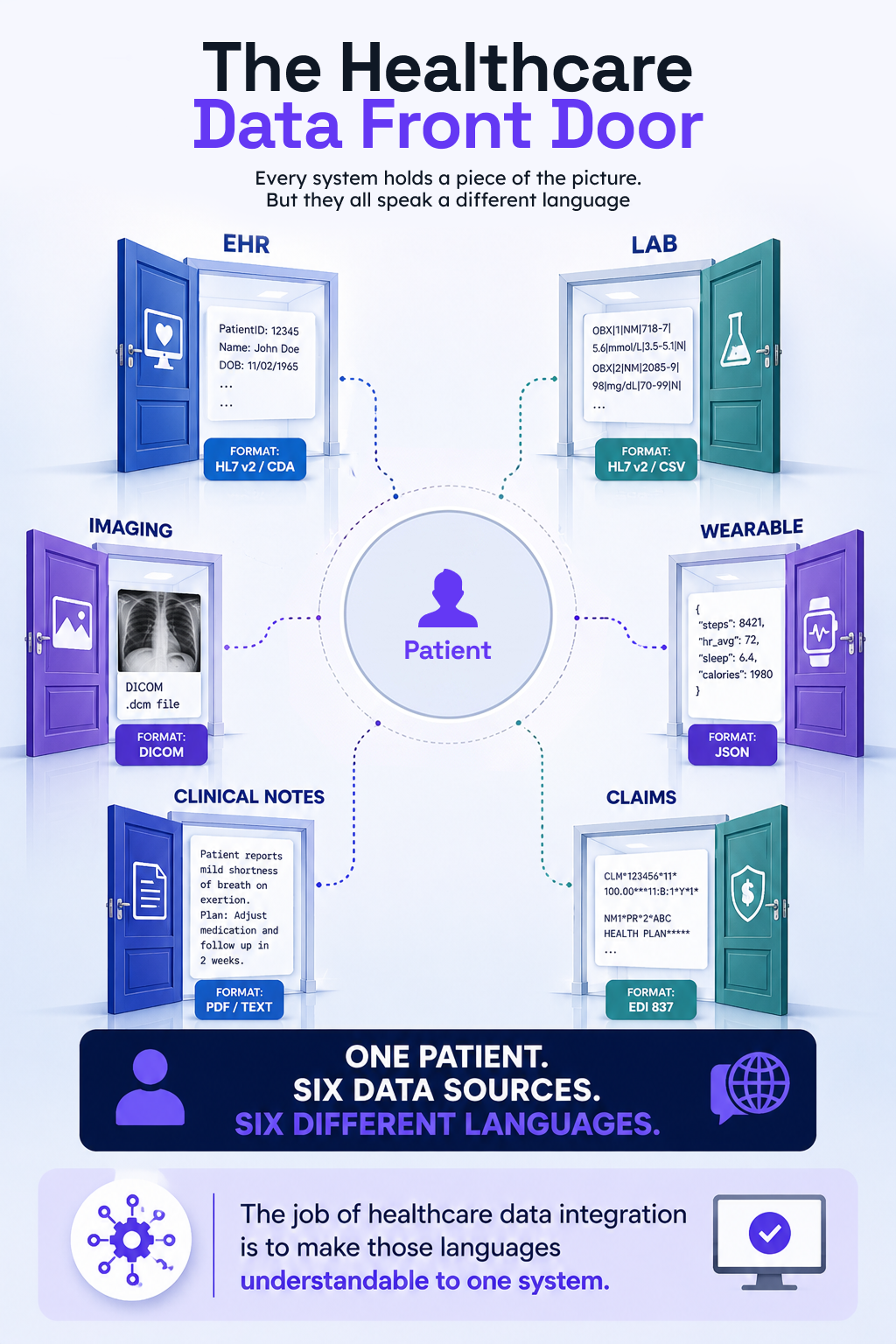
A patient walks into a clinic. An EHR creates a record. A lab produces results. A wearable records heart rate. An imaging system produces a CT scan. A physician writes a clinical note. A payer processes a claim. A patient sends information through an app.
All of that is healthcare data. However, all that data is created in different formats by different systems that often don’t talk to each other.
For a HealthTech founder, that creates a problem that is much bigger than an integration project.
It becomes a product problem.
If your application cannot reliably access, understand, standardize, and move healthcare data, everything downstream becomes harder: analytics, clinical workflows, AI, predictive models, patient experiences, compliance, and eventually scale.
That is why healthcare data integration should not be treated as plumbing hidden behind the product.
It is part of the product.
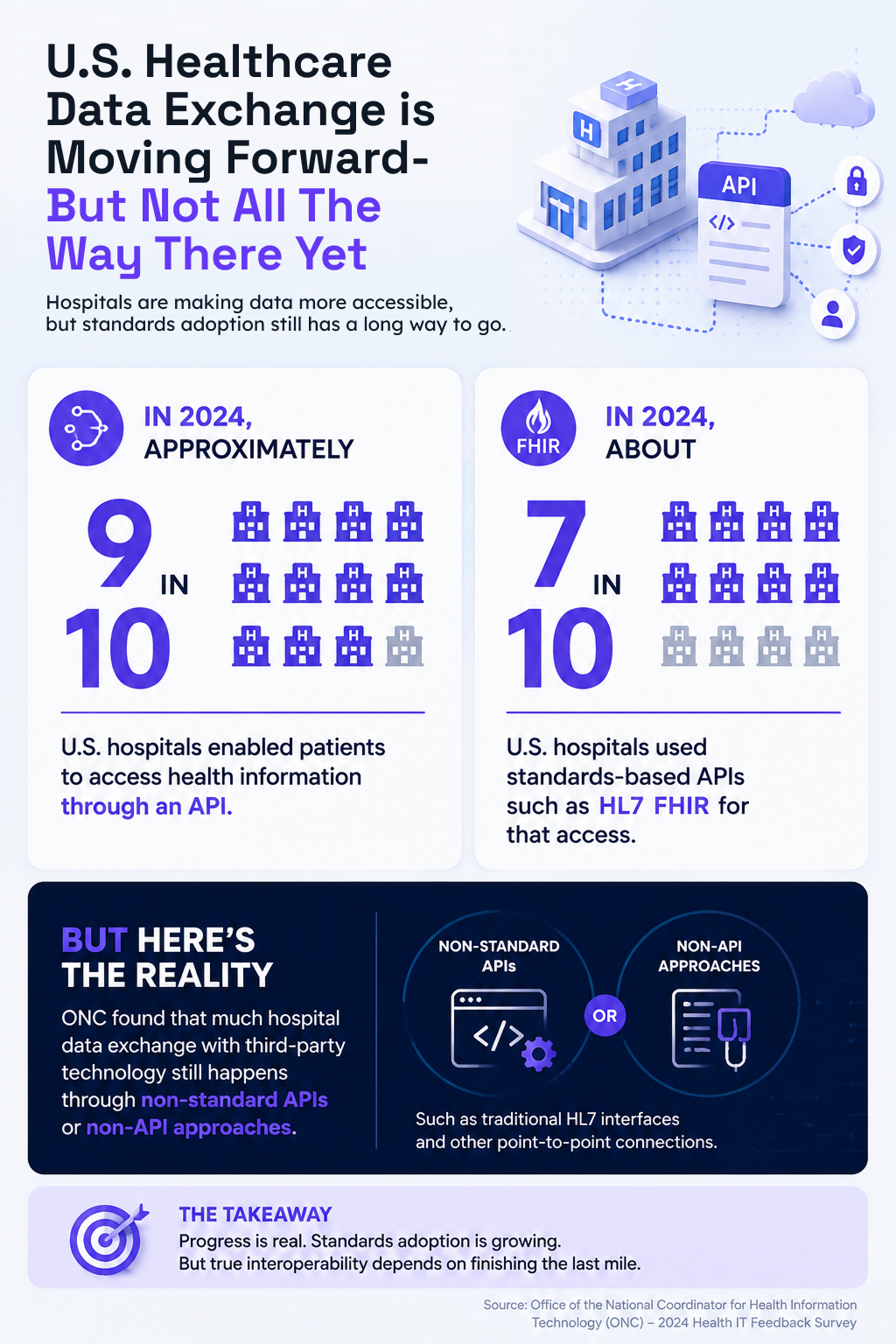
In fact, the U.S. healthcare ecosystem is already moving toward more standardized exchange. In 2024, approximately 9 in 10 U.S. hospitals enabled patients to access health information through an API, while about 7 in 10 used standards-based APIs such as HL7 FHIR for that access. Yet ONC also found that much hospital data exchange with third-party technology still happens through non-standard APIs or non-API approaches such as traditional HL7 interfaces.
So the question is no longer simply:
“Can my system connect to healthcare data?”
The better question is:
“Can my system turn fragmented healthcare data into reliable, usable, AI-ready information?”
That is the problem this blog solves.
The HealthTech Data Problem: Three Layers of the Architecture
So there are three connected layers:
1. Raw Data Channels, where healthcare data originates. 2. Intelligent Routing & Standardization, where that data is understood, mapped, validated, and transformed. 3. Downstream Value, where standardized data becomes useful for products, analytics, AI, diagnostics, and new healthcare experiences.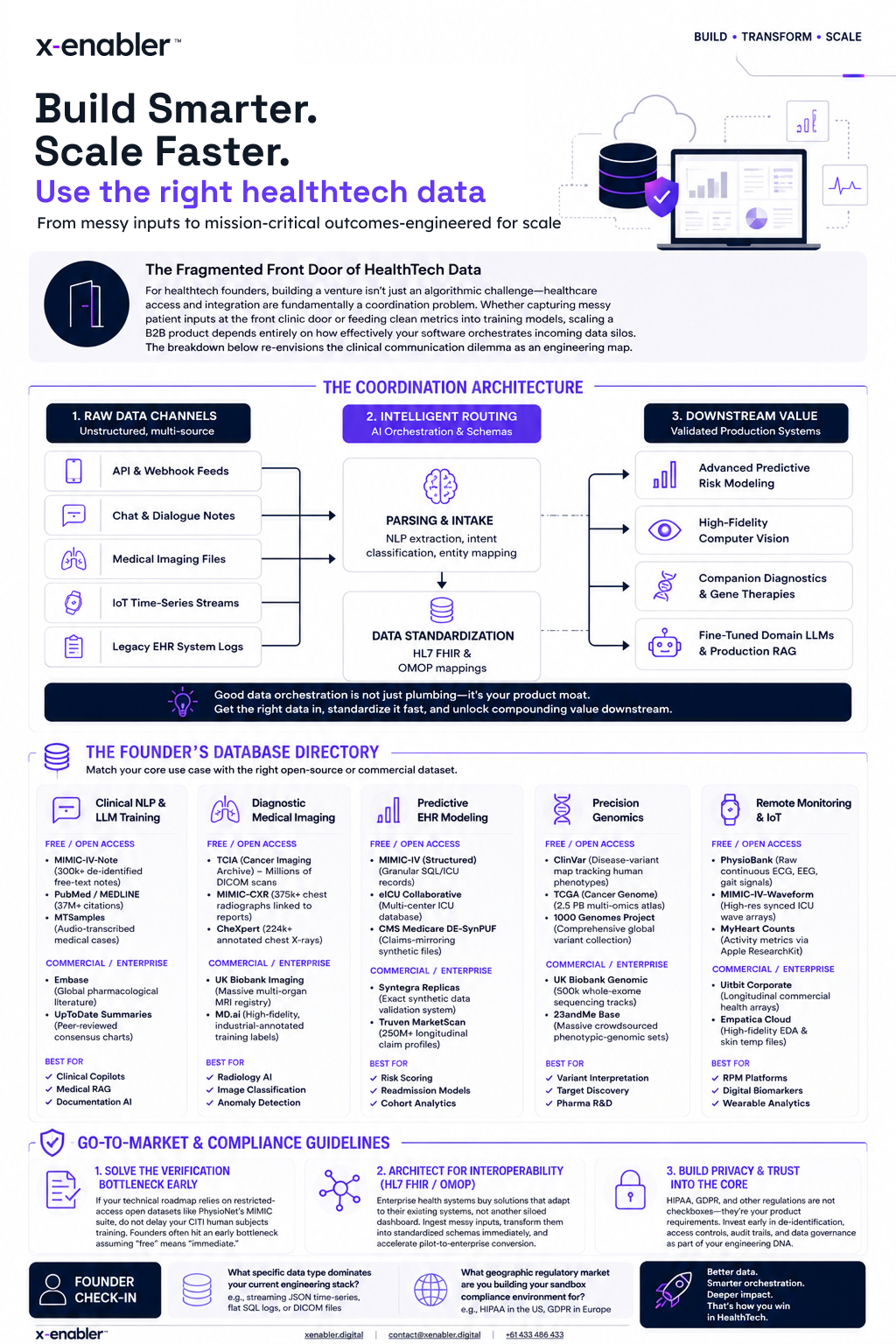
Around these three layers sit two important foundations:
- The right dataset strategy
- Privacy, security, interoperability, and compliance
Think of it as a simple equation:
Stage 1: Raw Data Ingestion Across Multi-Source Channels
Building a healthcare data system starts with being able to get data from many different places.
Digital health solutions need to be able to get data from five major sources:
- API and Webhook Feeds: This is data that comes from modern digital health apps lab information systems and other digital diagnostics. This data is sent in a format called JSON.
- Chat and Dialogue Notes: Unstructured free-text narratives generated during physician-patient interactions, ambient clinical documentation feeds, and telehealth messaging portals.
- Medical Imaging Files: This is data that comes from images like X-Rays, CT scans, and MRIs. These files are very large. Need special handling.
- IoT Time-Series Streams: This is data that comes from devices that monitor patients remotely like devices and bedside monitors. This data is sent constantly. Needs to be handled in real time.
- Legacy EHR System Logs: This is data that is stored in electronic health records systems, like Epic and Cerner. This data is often stored in formats and needs to be converted to be useful.
Digital health solutions must be able to handle all these types of data to build a robust healthcare data infrastructure. It all starts with being able to get data from many different places.
Stage 2: Intelligent Routing (AI Orchestration & Schemas)
Raw data can't directly run enterprise applications without being changed. The Intelligent Routing layer acts like the control system of your engine doing two important things:
-
Parsing and Intake (NLP Extraction, Intent Classification and Entity Mapping): Text and audio that isn't organized go through special clinical Natural Language Processing (NLP) data sets and named entity recognition processes.
Clinical notes that aren't organized are automatically checked to find ideas like diagnoses, instructions for medicine and parts of the body.
These are then connected to ways of describing medical information like SNOMED-CT (Systematized Nomenclature of Medicine – Clinical Terms), RxNorm and ICD-10 (International Classification of Diseases, 10th Revision).
-
Data Standardization (HL7 FHIR and OMOP Mappings): To make sure different health data can work together information from places is made into new standard formats.
Connecting to HL7 FHIR changes complicated information into FHIR JSON information (like Patient, Observation, Condition, Encounter).
Concurrently, mapping observational data to the OMOP (Observational Medical Outcomes Partnership) Common Data Model enables standardized analytics across disparate clinical databases without altering underlying data definitions.
Engineering Key Takeaway
According to research published by the Office of the National Coordinator for Health Information Technology (ONC), over 96% of non-Federal acute care hospitals in the United States have adopted certified EHR technology.
However, data silo fragmentation remains the single largest operational friction point. Establishing automated FHIR and OMOP transformation layers early reduces client onboarding times from months to days.Stage 3: Downstream Value Creation & Production Deployments
Once data is standardized and routed through high-throughput pipelines, it transitions to a valuable resource that can help create real results: :
- Advanced Predictive Risk Modeling: Using data that has been made consistent and time-based information from health records lets computers predict if patients will come back to the hospital, how diseases might get worse the chances of getting sepsis, and if someone might not survive in the ICU.
- High-Fidelity Computer Vision: Data that has been made consistent and labeled feeds powerful computer programs that find problems in images help decide which patients need attention first and show the parts of the body clearly.
- Companion Diagnostics & Gene Therapies: Combining information about genes with details about how patients are doing helps find new medicines, spots important signs of disease, and picks the best treatments for each person.
- Fine-Tuned Domain LLMs & Production RAG: Highly structured, clean clinical data powers Retrieval- Augmented Generation (RAG) architectures, allowing enterprise AI assistants to query patient records with zero hallucination risk.
So, healthcare AI does not fail because there is not enough data; it fails because the right data is often fragmented, inconsistent, poorly structured, or trapped across systems that were never designed to work together.
For HealthTech founders, CTOs, and product leaders, healthcare data infrastructure is therefore not just technical plumbing, it is a strategic product capability.
The ability to ingest data from EHRs, clinical notes, imaging systems, devices, APIs, and legacy platforms; standardize it using HL7 FHIR, OMOP, clinical NLP, and terminology mapping; and make it securely available to downstream applications is what creates an AI-ready foundation.
Once that foundation is reliable, organizations can build predictive models, clinical AI, computer vision, RAG systems, and personalized healthcare experiences with greater speed and confidence.
Build the data foundation once, build intelligence on top of it many times. Build smarter. Scale faster. Use the right HealthTech data.
Interested in learning more about x-enabler?
Leave a comment!