
How do you gather meaningful customer feedback for your startup?

A SaaS founder I worked with last year ran a 60-person survey, held three focus groups, and collected over 400 NPS responses. She had data coming out of her ears. Six months later she shipped her most-requested feature. Adoption was under 4%.
She didn’t have a listening problem. She had a source problem. She’d been collecting feedback from the loudest voices in her community instead of the people who were actually spending money, switching workflows, and living with the pain every day.
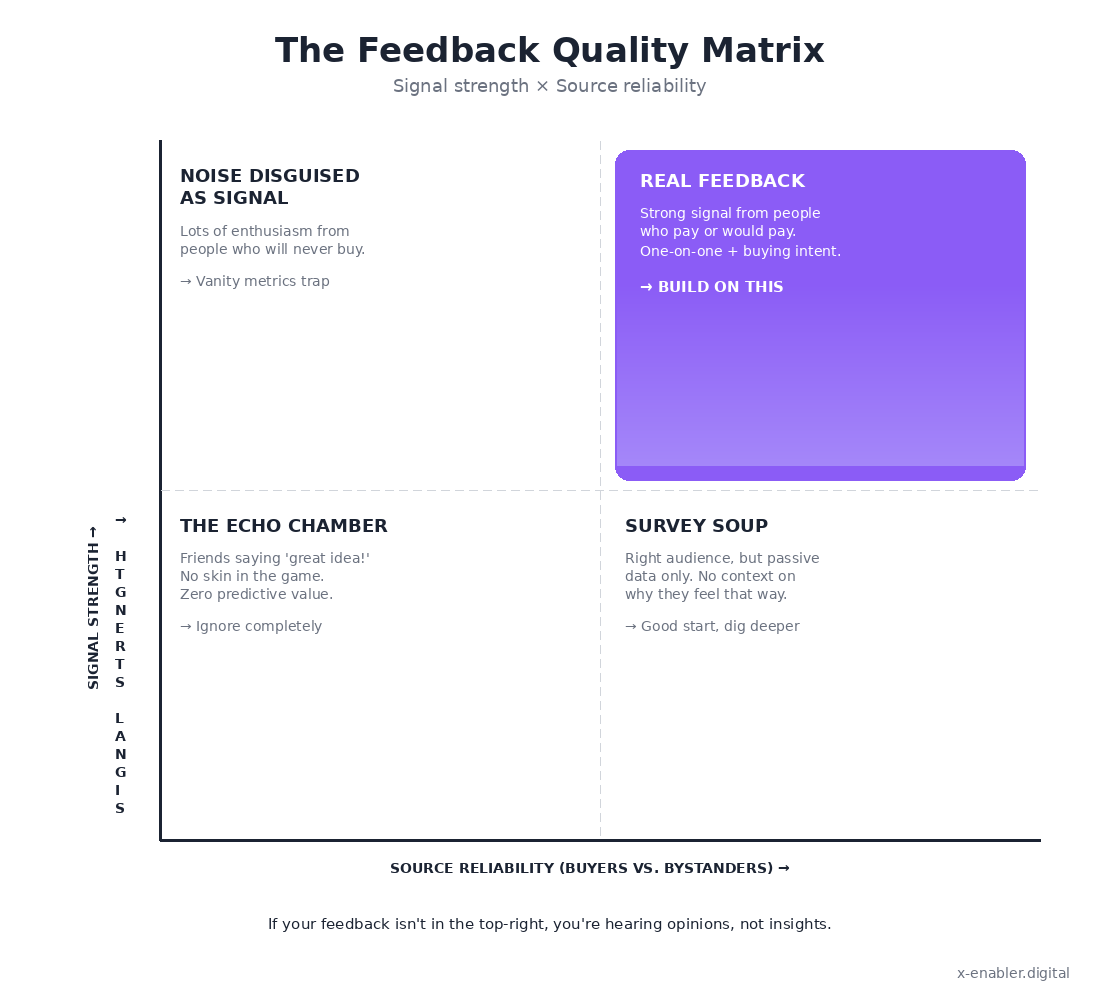
I spend a good chunk of my week telling founders that what they’re calling “customer feedback” is actually audience applause. Those are different things, and the difference is usually a wasted quarter and a feature nobody touches.
Here’s a simple way to think about it. It’s not a magic framework. It’s the same set of habits the best product founders run on instinct, condensed into something you can actually start doing this week.
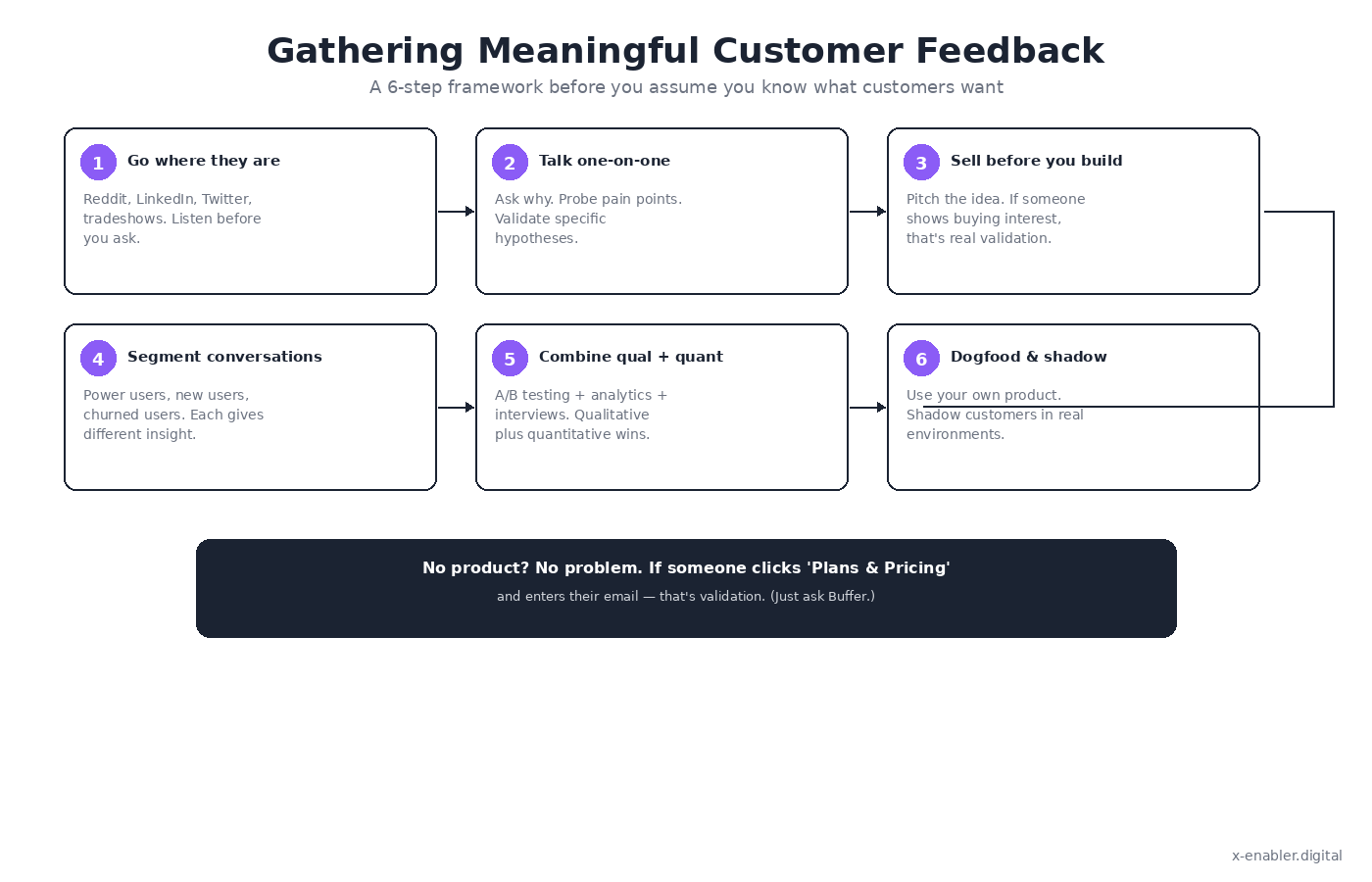
The 6-step customer feedback flow
Reddit, LinkedIn, Twitter, tradeshows. Listen before you ask.
You can ask why. You can probe pain points. You can validate specific hypotheses.
Pitch the idea or feature even if it’s not built. If someone shows real buying interest, that’s strong validation.
Talk to power users, new users, churned users. Each gives different insight.
A/B testing and analytics help. Qualitative plus quantitative works best.
Use your own product like a customer. Shadow customers in real environments. This reveals edge cases they never mention.
Step 1 — Go where your customers already hang out
Most founders build feedback loops that start with the product. A popup survey. An in-app NPS widget. A Typeform link in the onboarding email. That’s fine, but it only catches people who are already inside your world. The richest feedback lives where your customers complain naturally, before they ever find you.
Reddit threads at midnight. LinkedIn comments under a competitor’s post. Twitter rants about the tool they’re stuck using. Industry tradeshows where the hallway conversations matter more than the keynotes. Go there first. Listen before you ask.
The reason this matters is that unprompted complaints are the most honest signal you’ll ever get. Nobody writes a 300-word Reddit post at 1 a.m. because they’re mildly inconvenienced. That’s real pain. That’s data you can’t buy with a survey.
Step 2 — Talk to people one on one
Surveys scale. Conversations don’t. And that’s exactly why conversations are more valuable at the early stage.
When you sit across from someone, on a call, in a coffee shop, at a tradeshow booth, you get things a survey will never give you. You can ask why. You can probe pain points that they didn’t even realize they had. You can validate specific hypotheses by watching their face when you describe your solution. If they lean in, that’s one thing. If they start checking their phone, that’s data too.
Three questions that do most of the heavy lifting in a one-on-one:
- "Walk me through the last time this problem hit you." (Forces them into specifics, not generalities.)
- "What did you do about it?" (Reveals the substitute and the pain tolerance.)
- "If this problem disappeared tomorrow, what changes for you?" (Tells you whether it’s a painkiller or a vitamin.)
Notice what’s missing: "Would you use this?" That question is worthless. Everyone says yes. Ask about their past behavior, not their future intentions. Mom Test rules apply.
Step 3 — Try to sell before you build
This is where feedback stops being theoretical and starts becoming evidence.
Pitch the idea or feature, even if it’s not built yet. Describe it clearly. Show a mockup, a landing page, even a napkin sketch. Then watch what happens. If someone nods and says “cool”, that tells you nothing. If someone asks “When can I get this?” or “How much will it cost?” or pulls out their phone to show their boss — that is strong validation.
Take Buffer, for example. Joel Gascoigne launched a simple landing page with no product — just the idea. When users clicked “Plans & Pricing” and entered their emails, it showed real buying intent. No code. No product. Just a page and a pricing button. The people who clicked past the pricing page were the feedback. Everything else was noise.
Money is the only honest signal. Compliments are free. LinkedIn likes are free. A credit card number is not. If you can’t get a single person to put even a small amount of skin in the game before the product exists, the feedback you’ve been collecting might be applause, not demand.
Step 4 — Segment your conversations
Not all feedback is created equal, because not all customers are in the same place.
A power user who has been with you for eighteen months will tell you what’s missing from the advanced workflow. A new user who signed up yesterday will tell you what’s confusing in the first five minutes. A churned user who left last quarter will tell you what finally made them walk. Each gives different insight, and mixing them together gives you nothing.
Here’s how I think about it:
- Power users tell you where the ceiling is. What’s blocking them from doing more?
- New users tell you where the floor is. What’s stopping them from getting started?
- Churned users tell you where the exit door is. What finally made the pain of staying worse than the pain of leaving?
- Prospective buyers tell you what the market actually wants before they’ve been shaped by your product.
When you lump all four together, the signal cancels out. When you segment, patterns jump off the page.
Step 5 — Combine qualitative with data
Conversations tell you why. Data tells you how often and how many. You need both.
A user interview might reveal that onboarding feels overwhelming. That’s a hypothesis. A/B testing the onboarding flow and watching the drop-off numbers — that’s evidence. A churned-user call might suggest that the pricing feels too high. Cohort analysis on price sensitivity across segments — that’s the other half of the picture.
Qualitative without quantitative is storytelling. Quantitative without qualitative is guessing. The best product teams I’ve worked with run both in parallel, not sequentially. They don’t wait for a survey to finish before talking to users. They don’t run experiments without first understanding the context. They interleave.
Step 6 — Shadow customers to get real-time insights
This is the step most founders skip because it feels uncomfortable. But it’s the one that catches the problems nobody will ever report.
Shadowing means watching a real customer use your product in their real environment. Not a usability lab. Their desk, their second monitor, their browser with forty-seven tabs open. This reveals edge cases, workarounds, and friction points they would never think to mention in a feedback form because they’ve already adapted.
The combination of dogfooding and shadowing fills the gap between what customers tell you and what they actually do. That gap is where the best product insights live.
So what does this actually look like in practice?
When we run customer discovery sprints with founders at x-enabler, we usually find one of three things in the first two weeks:
- The founder is collecting feedback from the wrong segment. (Most common. Redirect the conversations, keep the product.)
- The feedback is real and the product direction is right. (Rare. Double down.)
- The founder has lots of feedback but none of it translates to buying intent. (More common than founders want to admit. Go back to Step 3.)
Outcome #3 is the one nobody wants but everyone needs. It’s also the cheapest outcome you’ll ever get, if you catch it before you’ve burned a quarter building features that came from applause instead of demand.
The most expensive feedback is the kind that makes you feel good but doesn’t make anyone reach for their wallet.
A question I’d genuinely like to hear your answer to: what real action would make you confident enough to go all in on your idea? Not a survey result. Not a thumbs-up from a friend. What concrete, costs-something signal would make you write the first line of code? Reply, or send me a note. I read everything.
Interested in learning more about x-enabler?

Leave a comment!