
How to assess whether an idea represents a real market gap?

A founder once walked into our office with a 47-slide deck and a number that was hard to ignore: $420,000 spent, eleven months of engineering, and a flagship feature shipped to production. He was now back to raise a bridge round. The product worked. The feature was elegant. Almost nobody used it.
He didn't have a build problem. He had a gap problem. He'd built something he thought the market needed instead of something the market was already paying, in time, money, or workarounds, to solve.
I spend most of my week telling founders that what they're describing is not a market gap. It's a feature they find interesting. Those are different things, and the difference is usually six to eighteen months of runway.
Here's the way I think about it. It's not a magic framework. It's the same set of questions a good investor would ask, condensed into something you can actually run on a Tuesday afternoon.
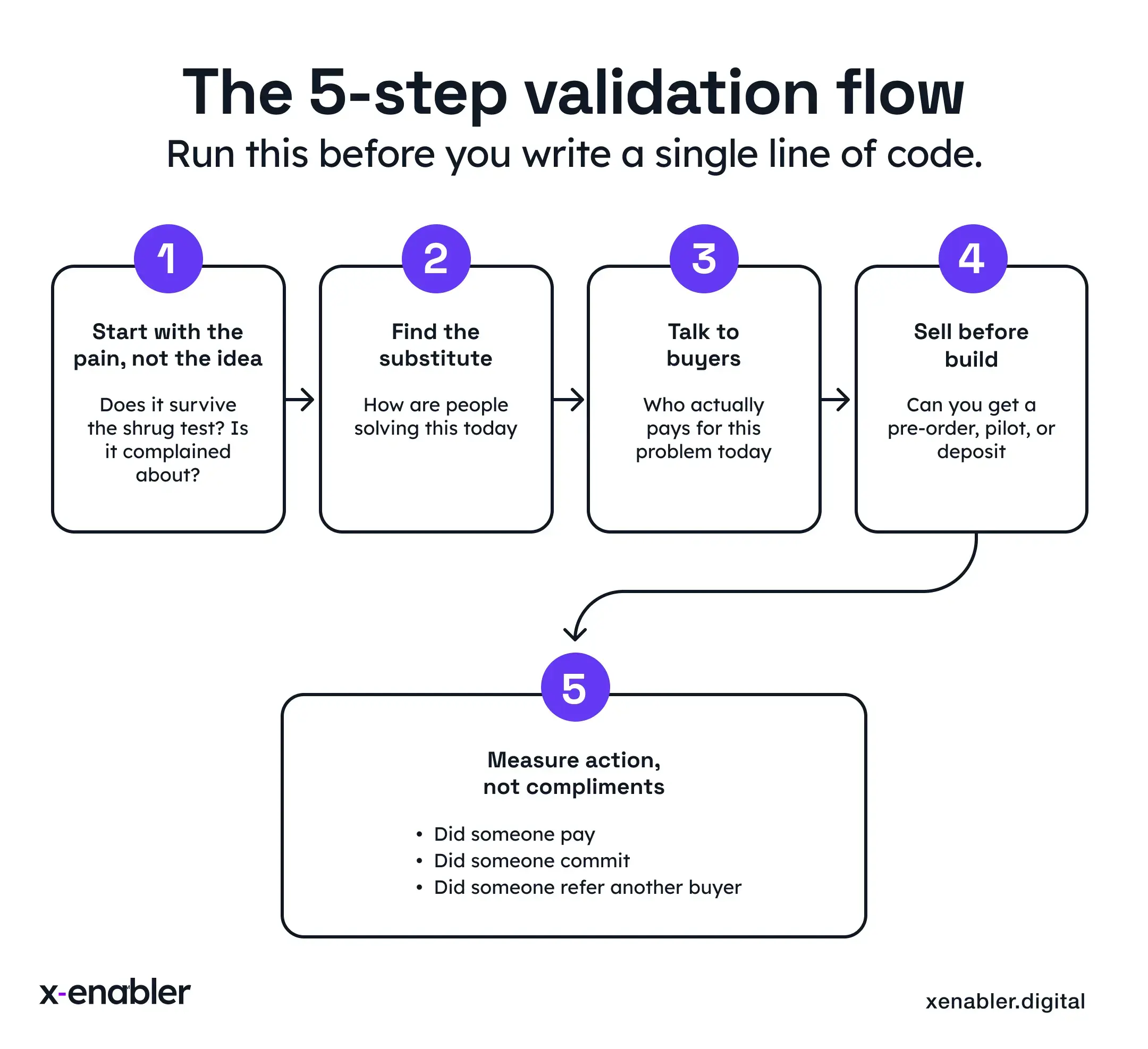
The 5-step validation flow
- Did someone pay
- Did someone commit
- Did someone refer another buyer
Step 1 — Start with the pain, not the idea
A real gap is a problem people complain about without being prompted. It surfaces in Slack rants, in Reddit threads at 1 a.m., in the workaround spreadsheet that has 14 tabs and a person whose entire job is maintaining it.
Here's the test I use: if you remove the word "should" from the problem, does it still exist? "People should track their water intake better" is not a gap. "Pharmacy techs are manually reconciling 200 insurance rejections a day on a Friday" is a gap. One is an opinion. The other is a workflow that's already costing someone real money.
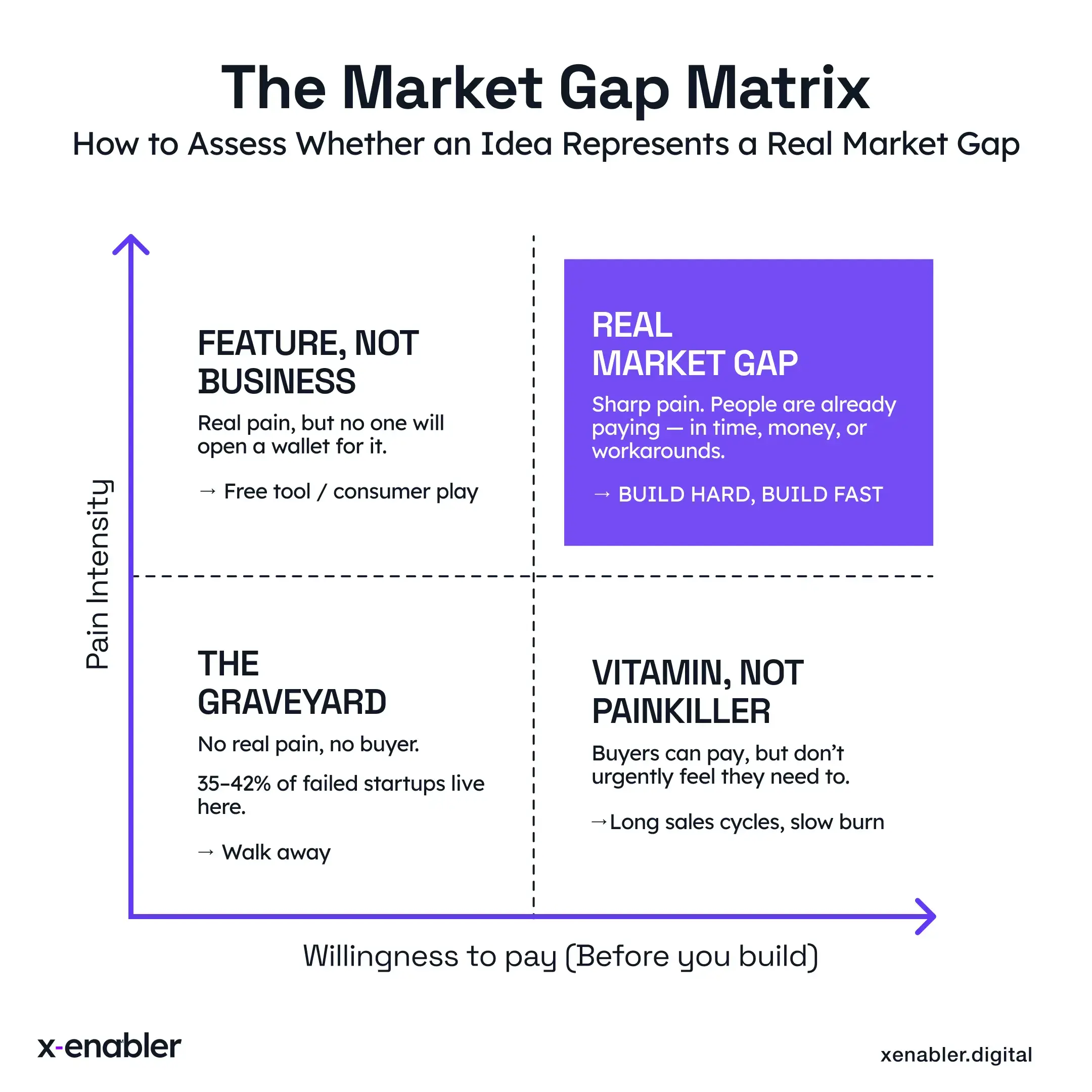
CB Insights has been running their post-mortem analysis on failed startups for over a decade. The number one reason startups die, ahead of running out of cash, ahead of bad teams… is "no market need," at around 35–42% of failures depending on the year. The founders weren't lazy. They built well. They just built into a gap that wasn't there.
Step 2 — Look for the substitutes (not the competitors)
If your "gap" has no substitute, no spreadsheet, no consultant, no Zapier hack, no intern doing it manually, that's almost never a sign of a clear runway. It's usually a sign that the pain isn't sharp enough for anyone to bother.
When Airbnb launched, the substitute was Craigslist plus a phone call plus a leap of faith. When Notion launched, the substitute was four different SaaS tools held together with copy-paste. The substitute is the proof that the pain is real. The opportunity is making the substitute look ridiculous.
So when a founder tells me "there's no competition," I get nervous. When they tell me "people are currently solving this with three browser tabs, a WhatsApp group, and a Google Sheet that breaks every Monday", now we're talking.
Step 3 — Talk to buyers, not friends
Twenty conversations with people who would actually swipe a card beats two hundred "that's a great idea" comments from your network. Three questions do most of the work:
- How are you solving this today? (Tells you the substitute, and how painful it is.)
- What is it costing you — in hours, dollars, or lost revenue? (Tells you the size of the wallet.)
- What happens if you don't fix it in the next six months? (Tells you the urgency. If the answer is "nothing really," walk away.)
Notice what's missing: "Would you use this?" That question is worthless. Everyone says yes. Mom Test rules apply; ask about their past behavior, not their future intentions.
Step 4 — Try to sell it before you build it
This is the step that separates the founders who ship from the founders who re-pitch. Before you write a line of code, see if someone will commit. A pre-order. A signed LOI. A paid pilot at 30% of the eventual price. A deposit. Anything that converts an opinion into a transaction.
The reason this works is that money is the only honest signal. Compliments are free. LinkedIn likes are free. Even meetings are mostly free. A wire transfer is not. If you cannot get a single person to put even a small amount of skin in the game before the product exists, the gap probably isn't where you think it is — and you've just saved yourself nine months and a meaningful chunk of your runway by finding out cheaply.
Step 5 — Measure action, never compliments
When you're trying to validate, the only metrics that matter are the ones that cost the user something:
- Payment — they parted with money.
- Commitment — they put their name on something or blocked their calendar.
- Referrals — they sent another buyer your way unprompted.
Everything else is vanity. Page views, signups for a free waitlist, "looks cool!" replies — none of those have ever paid a salary.
Think about Facebook in its first month. It wasn't a clever product. It was a basic directory for Harvard students. But within 24 hours, more than half of Harvard's undergraduate population had signed up, and within a month other universities were asking to be added. That's the signal. Not the feature set, not the design, the unprompted pull from people who weren't asked.
So what does this actually look like in practice?
When we run the D.E.S.I.G.N validation sprint with founders at x-enabler, we usually find one of three things in the first two weeks
- The gap is real, but the founder's solution is wrong. (Most common. Pivot the how, keep the what.)
- The gap is real and the solution is roughly right. (Rare. Build hard, build fast.)
- The gap doesn't exist. (More common than founders want to admit. Stop. Save the money.)
Outcome #3 is the one nobody wants but everyone needs. It's also the cheapest outcome you'll ever buy, if you find it before you've spent eleven months and $420,000 building the wrong thing.
The most expensive line of code is the one written before anyone has asked, in real money, for what it's supposed to do.
A question I'd genuinely like to hear your answer to: what's the strongest validation signal you've ever gotten before writing a line of code? Reply, or send me a note. I read everything.
P.S. If you want the one-page checklist I run founders through in the first 30 minutes of every validation conversation, I've put it together as a free download. → Grab the Market Gap Checklist
Interested in learning more about x-enabler?



Leave a comment!